
You know that moment. The one where a huge opportunity—a major new client, a breakthrough product launch, a sudden market opening—lands on your desk. It's the moment you've been working toward. But instead of pure excitement, a knot of anxiety tightens in your stomach.
Can our systems actually handle this?
This is the expansion trap. It's where your own success becomes your biggest operational risk. Suddenly, your "good enough" IT infrastructure isn't just slow; it's a liability. Every frozen application, every dropped connection, every minute of downtime starts bleeding cash.
And let's be honest, it's a lot of cash. According to industry data, IT downtime costs businesses an average of $5,600 per minute. For a growing company, an outage during a critical period isn't just an inconvenience; it's a catastrophic failure that can erode profit, damage your reputation, and hand a win to your competitors.
Building a scalable IT infrastructure isn't a technical problem for your IT department to solve. It's a core business strategy that directly impacts your bottom line, your ability to innovate, and your capacity to survive the future. This guide is designed for decision-makers—the leaders who need to understand the why and the how much before signing off on the how. We'll move past the jargon and focus on the financial justification, risk mitigation, and future-proofing required to turn your technology from a bottleneck into your most powerful growth engine.
Table of Contents
- Step 1: The Honest Scalability Assessment
- What Does "Scalable" Actually Mean? Horizontal vs. Vertical Growth
- Your Quick-Audit Checklist for Current Bottlenecks
- Step 2: The Financial Imperative of Smart Scaling
- The TCO Framework: On-Premise vs. Cloud vs. Hybrid
- Unlocking the ROI: Where the Real Savings Are
- Step 3: Designing for a Future That's Already Here
- The Edge Shift: Why Your Data is Leaving the Building
- The Generative AI Workload: Planning for the 5x Data Tsunami
- Step 4: Managing Risk, From the Server Room to the C-Suite
- Security That Scales With You: The Zero-Trust Mindset
- Controlling the "Blast Radius" with Policy-as-Code
- Your Next Move: From Strategy to Action
- Frequently Asked Questions About Scalable Infrastructure
Step 1: The Honest Scalability Assessment
Before you can build a roadmap for the future, you need an honest map of where you are right now. Too many businesses operate on infrastructure that was designed for a company they used to be five years ago. Let's start with a clear definition and a simple audit.
What Does "Scalable" Actually Mean? Horizontal vs. Vertical Growth
When IT folks talk about scalability, they're usually talking about two primary directions. Think of it like real estate.
Vertical Scaling (Scaling Up): This is like adding another floor to your existing building. You take a single server and you make it more powerful—more RAM, a faster CPU, more storage. It's straightforward and can solve immediate performance issues. But there's a hard limit. Eventually, you can't build any higher, and the cost for that top floor becomes astronomical.
Horizontal Scaling (Scaling Out): This is like buying the lot next door and building a second, identical building. Instead of making one machine bigger, you add more machines to the system, distributing the workload across them. This approach is the foundation of the modern cloud. It's incredibly flexible and, in theory, has no limit. But it also introduces complexity in managing all those interconnected systems.
The goal isn't to choose one over the other. A truly scalable system uses a combination of both, a concept known as elasticity—the ability to automatically add or remove resources precisely when you need them.
Your Quick-Audit Checklist for Current Bottlenecks
You don't need to be a systems engineer to spot the warning signs. Grab your team and ask these questions. The answers will tell you where the cracks are already starting to show.
Performance Under Load: What happens on the last day of the quarter when everyone is running reports? Or during a big marketing push? Do applications grind to a halt? This is your most obvious stress test.
Time to Deploy: If a new team member starts on Monday, how long does it take to get them fully provisioned with the tools they need? Hours? Days? This reveals manual process bottlenecks that won't scale.
Data Access & Speed: Are remote employees or those at branch offices constantly complaining about slow file access? Does your team avoid using the VPN because it's a productivity killer? This points to a centralized system that can't handle a distributed workforce.
Recovery Time: If your main server went down right now, how long would it really take to get back up and running? Be honest. Is it minutes, or is it a "call everyone and hope for the best" scenario? This is your disaster recovery gap.
Answering "yes" to any of these doesn't mean you've failed; it just means you've outgrown your current setup. It's time to look at the numbers.
Step 2: The Financial Imperative of Smart Scaling
For any CFO or CEO, the conversation about infrastructure inevitably comes down to one thing: cost. But simply comparing server price tags is a rookie mistake. The real financial picture is revealed through Total Cost of Ownership (TCO) and Return on Investment (ROI).
The TCO Framework: On-Premise vs. Cloud vs. Hybrid
Let's break down the true costs associated with the three primary infrastructure models. It's rarely as simple as it looks.
| Cost Factor | On-Premise (The Fortress) | Public Cloud (The Renter) | Hybrid Cloud (The Best of Both) |
| Initial Cost (CAPEX) | Very High. Servers, networking gear, physical space, power, cooling. | Very Low. Pay-as-you-go, no upfront hardware costs. | Moderate. Uses existing on-premise assets combined with cloud services. |
| Ongoing Cost (OPEX) | High. Power, cooling, maintenance contracts, IT staff salaries. | Variable. Can be high if not managed properly. You pay for what you use. | Optimized. Predictable costs for on-premise, variable for cloud bursts. |
| Scalability Cost | High & Slow. Requires purchasing and installing new hardware. | Low & Fast. Scale up or down with a few clicks. | Flexible. Use the cloud for unpredictable demand, keeping base load on-prem. |
| Hidden Costs | Hardware lifecycle management, property taxes, physical security. | Data egress fees (getting your data out), cost of over-provisioning. | Complexity of managing two environments, integration challenges. |
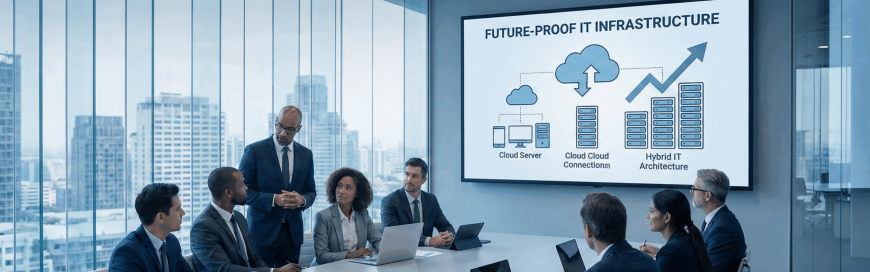
As the chart shows, the conversation is shifting from "which one is cheapest?" to "which model gives us the most strategic flexibility?" For most growing businesses, the answer is a hybrid approach. It allows you to leverage your existing investments while gaining the agility and power of the cloud where it makes the most sense.
Unlocking the ROI: Where the Real Savings Are
The true financial power of a modern, scalable infrastructure isn't just about reducing hardware costs. It's about unlocking efficiency across your entire organization.
Look, the data is compelling. A study by Altair found that investing in cloud automation and orchestration yields an incredible 136% ROI over three years. Why? Because you stop paying your smartest people to do manual, repetitive tasks. They can focus on innovation instead of just keeping the lights on.
And it's not just an enterprise game. A recent survey found that 82% of small and medium-sized businesses reported genuine cost savings after adopting the cloud. These savings come from:
- Reduced Downtime: Less time lost to outages means more time spent serving customers and generating revenue.
- Increased Productivity: When systems are fast and reliable, your team gets more done. It's that simple.
- Better Security: Proactive, automated security is far more effective and less costly than cleaning up after a breach. A robust cybersecurity posture is a direct result of well-architected infrastructure.
The bottom line is that a strategic investment in scalability isn't a cost center. It's a high-return investment in operational excellence.
Step 3: Designing for a Future That's Already Here
Future-proofing isn't about predicting the future; it's about building a system that's agile enough to adapt to it. And two massive shifts are happening right now that your infrastructure must be ready for: the move to the Edge and the explosion of AI.
The Edge Shift: Why Your Data is Leaving the Building
For decades, IT was centralized. Everything happened in the data center or, more recently, in a central cloud. That era is ending.
Gartner predicts that by 2025, a staggering 75% of all enterprise-managed data will be generated and processed outside a traditional data center or cloud. This is the "Edge"—your remote offices, your factory floor, your retail locations, your agricultural sensors in the field.
Think about what this means. If a manufacturing plant in a rural area relies on a central cloud in Seattle to process quality control data, the lag could be disastrous. The decision needs to happen at the edge, right where the data is created. This requires a decentralized infrastructure model where remote sites have their own computing power but are still managed centrally. For businesses in the Pacific Northwest—from agriculture to manufacturing—this isn't a distant concept; it's an immediate competitive advantage.
The Generative AI Workload: Planning for the 5x Data Tsunami
The buzz around Generative AI is more than hype; it's a fundamental shift in computing. But running these powerful models requires immense processing power. IDC estimates that GenAI use cases can increase computing workloads and data traffic by up to five times.
If your current network struggles with month-end reports, it stands no chance against this new wave. Preparing for AI means architecting for:
- Massive Parallel Processing: The ability to break down huge tasks and run them across many systems at once.
- High-Speed Networking: Low-latency connections are critical for moving the enormous datasets AI models require.
- Modular Design: Building your infrastructure with independent, swappable components (like microservices) so you can upgrade your AI engine without rebuilding everything else.
Ignoring these trends is like building a new highway with only one lane. You're creating a bottleneck before you even open for traffic.
Step 4: Managing Risk, From the Server Room to the C-Suite
As your infrastructure grows, so does your attack surface. A scalable system must be a secure system by design, not as an afterthought. This requires a shift in thinking from building walls to creating an environment of automated trust and control.
Security That Scales With You: The Zero-Trust Mindset
The old "castle-and-moat" model of security—a strong firewall with a trusted network inside—is dead. In a world of remote work, cloud apps, and IoT devices, there is no "inside" anymore.
The modern approach is Zero-Trust, which operates on a simple but powerful principle: never trust, always verify. This means every user, every device, and every application must prove its identity and authorization before accessing any resource, regardless of where it is.
Implementing a Zero-Trust framework is a foundational part of scalable design. It ensures that as you add new users and services, your security policies automatically extend with them, preventing gaps that hackers love to exploit. This approach aligns perfectly with comprehensive cybersecurity services that protect your growing infrastructure.
Controlling the "Blast Radius" with Policy-as-Code
One of the biggest risks in a complex system is human error. A single mistyped command or a misconfigured setting can bring down an entire application or, worse, open a massive security hole.
This is where the concept of a "Blast Radius" comes in. How much damage can one mistake cause? Smart infrastructure design aims to minimize this radius. One of the most effective ways to do this is with Policy-as-Code (PaC).
Think of PaC as automating your company's rulebook. Instead of relying on a human to remember to apply a security patch or to configure a firewall correctly, you write those rules as code. The system then automatically enforces them. It can prevent a developer from launching a new server that isn't compliant with security standards or block a change that would exceed a department's budget. It's a safety net that protects you from your own best-intentioned mistakes and is a critical part of any serious backup and disaster recovery plan.
Your Next Move: From Strategy to Action
We've covered a lot of ground, from high-level financial strategy to the nitty-gritty of future-proof design. The takeaway is clear: building a scalable IT infrastructure is no longer an option for ambitious companies. It's the essential foundation for growth.
Your scaling strategy must be a hybrid strategy, leveraging the best of on-premise control and public cloud agility. It must be financially justified, validated by clear TCO and ROI models, not just upfront costs. And it must be future-ready, built to handle the decentralized, AI-powered world we're already living in.
This can feel overwhelming. But you don't have to do it alone. The first step is always the same: a comprehensive, no-obligation assessment of your current IT health. Understanding where you are today is the only way to build a practical, effective roadmap for where you want to go tomorrow. Key Methods offers a thorough IT health checkup to help you understand your current infrastructure and plan for scalable growth.
Frequently Asked Questions About Scalable Infrastructure
Q1: We hear "the cloud" is always the cheapest option. Is that true?
Not necessarily. While the public cloud has a very low upfront cost, the variable, pay-as-you-go model can lead to surprisingly high bills if not managed carefully. The "cheapest" option is rarely the best. A TCO analysis often reveals that a hybrid model—which strategically places workloads in the most cost-effective location—provides the best long-term value. Microsoft Azure offers scalable applications that can grow and change based on your needs while helping you reduce costs.
Q2: Our business isn't a tech company. Do we really need to worry about AI and the Edge?
Yes, absolutely. These technologies will impact every industry. The Edge is critical for any business with physical locations, from retail stores optimizing inventory to agricultural companies monitoring crop health. AI will transform everything from customer service chatbots to supply chain logistics. Not preparing for these shifts means you'll be playing catch-up to competitors who did.
Q3: How can we start this process without disrupting our day-to-day operations?
A big-bang overhaul is risky and disruptive. The best approach is a phased one. It starts with a thorough audit and health check to identify the most critical bottlenecks and risks. From there, you can build a migration and modernization plan that happens in manageable stages. Partnering with an expert in managed IT services ensures the process is smooth, strategic, and minimizes any impact on your team's productivity.